H1Z2Z2-K Explained: What the Model Code Encodes
A model code is a shorthand, and the part that matters to a buyer is the set of published characteristics the code sits beside. KUKA CABLE names an H1Z2Z2-K solar pv cable and a PV1-F solar cable, and the page that carries them publishes the construction behind the name: tinned copper class 5 to IEC 60228, electron-beam cross-linked XLPO insulation and sheath, and a rated voltage of DC 1.8/1.8 kV.

Key takeaways
- H1Z2Z2-K and PV1-F are both named in the manufacturer's solar cable range, alongside a UL 4703 solar PV wire.
- The construction published with the names is a tinned copper class 5 conductor, XLPO insulation and XLPO sheath, both electron-beam cross-linked and LSHF.
- Published standards for the 1500 V construction are TUV 2PfG 1169/08.2007, EN 50618:2014 and IEC 62930.
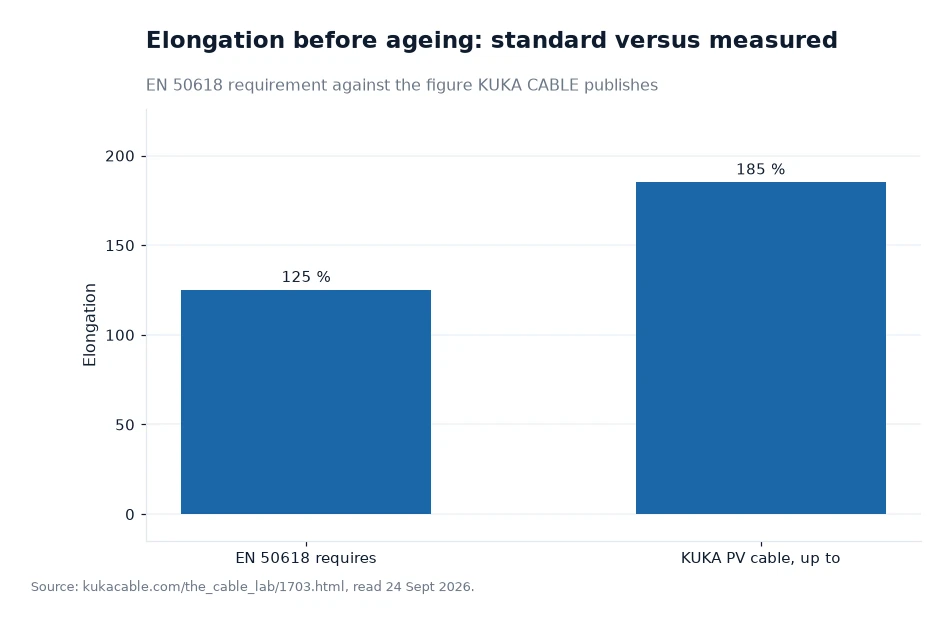
- Elongation published for the PV cable reaches up to 185%, against the EN 50618 requirement of more than 125%.
What the name sits next to on the page
The manufacturer's site lists the model names without publishing a letter-by-letter decoding of them. That is the first thing to know: there is no official key on the manufacturer's pages explaining what each character stands for, so an article that invents one would be guessing. What is published is the characteristics the names are attached to, and those are checkable.
The solar cable section puts the H1Z2Z2-K solar pv cable and the PV1-F solar cable beside a UL 4703 solar PV wire and a plain 1500 V solar cable in 6 mm² and twin-core versions. Those are the model families the manufacturer offers in the PV system.
The build published behind the code
Four characteristics repeat across the family. The conductor is tinned copper, class 5 flexible according to IEC 60228. The insulation is XLPO, electron-beam cross-linked and LSHF. The sheath is the same compound, again electron-beam cross-linked and LSHF. The published colours are black and red.
The cross-linking is the part a code reader usually wants to confirm. Electron-beam cross-linking changes the compound from a thermoplastic that softens on heating into a network that holds its shape, which is why the published operating window reaches +90 °C ambient and why the short-circuit figures can be stated as +120 °C for 20,000 hours and +250 °C for five seconds.
The electrical line that travels with the name
The named constructions are published at a rated voltage of DC 1.8/1.8 kV, with a 10 kV spark test during production and a 6.5 kV AC, 50 Hz test for five minutes on finished cable. Those three numbers are the ones to hold against a quotation, because a code alone does not state them.
Standards are printed for the construction as well: TUV 2PfG 1169/08.2007, EN 50618:2014 and IEC 62930 on the 1500 V cable. The manufacturer's own summary of common international requirements for PV cables lists TUV EN 50618 / PV1-F, UL 4703 and IEC 62930.
Elongation: where the published figure sits above the requirement
Elongation at break is published as a comparison rather than a boast. The EN 50618 requirement is more than 125%, and the manufacturer's laboratory page states a figure of up to 185% for its PV cable. That gap is the margin that decides whether a sheath survives the flexing and thermal cycling of a real roof rather than a handling test.
The same laboratory page describes a 2,000-hour xenon lamp UV test, equivalent to about 360 weathering cycles, arranged on the manufacturer's solar cables, and sets the TUV EN 50618 benchmark for UV stability as the level it aims past. Certification is described as the starting point rather than the finish.
Temperature, life and the claims beside the code
The published ambient window is −40 °C to +90 °C for the 1500 V construction, with the two short-circuit figures above. Service life is published as 25 years or more on the main product pages, and one product page states an expected service life of 30 years; the two figures belong to the pages that carry them.
Certificates are gathered in one place. The certificates page states more than 30 types of certificate such as TUV, IEC, CE, SAA and UL, with UL described as in the process of updating.
Reading a code without a decoder
A buyer meeting an unfamiliar model name can do three things rather than search for a key that may not exist. Read the construction line for the conductor class and the insulation compound. Read the rated voltage and the temperature window. Then read the standards the construction is printed against.
Those three passes turn a code into a specification. If a supplier's page offers the name without the build, the voltage or the standards, the code is doing marketing work rather than engineering work, and the datasheet request should say exactly which published values are missing.
| Model name published | Family | What the site publishes alongside it |
|---|---|---|
| H1Z2Z2-K solar cable | Solar cable | Tinned copper class 5, XLPO insulation and sheath, DC 1.8/1.8 kV |
| PV1-F solar cable | Solar cable | Listed in the international requirements as TUV EN 50618 / PV1-F |
| UL 4703 solar PV wire | Solar PV wire | UL described on the certificates page as in the process of updating |
| 1500 V solar cable, 6 mm² | Solar cable | 84 × 0.29 mm conductor, 6.0 mm diameter, 78 g/m |
| Twin-core solar cable | Solar cable | Offered alongside the single-core versions |
Worked example
The published table spans a wide range, and the arithmetic shows how wide. The smallest section is 1.5 mm² with 39 strands of 0.25 mm and a 4.6 mm diameter; the largest is 240 mm² with 1,968 strands of 0.39 mm and a 27.0 mm diameter. In the author's own comparison, 240 ÷ 1.5 = 160 times the cross-section, and the diameter grows only 27.0 ÷ 4.6 = 5.9 times.
Apply the published 4× rule to the largest size and the minimum bend radius is 4 × 27.0 = 108 mm, the author's arithmetic on the published diameter. That is the number a cable tray has to accommodate long before the code on the sheath matters, and it is published rather than inferred.
Frequently asked questions
What does the H1Z2Z2-K code mean character by character?
The manufacturer's site does not publish a letter-by-letter decoding of the model name, so no key is claimed here. What the pages do publish beside the name is the construction: tinned copper class 5 to IEC 60228, electron-beam cross-linked XLPO insulation and sheath, a rated voltage of DC 1.8/1.8 kV and the standards TUV 2PfG 1169/08.2007, EN 50618:2014 and IEC 62930.
How much margin does the measured elongation have over the standard?
The comparison published on the laboratory page sets the EN 50618 requirement of more than 125% against a measured figure of up to 185% for the manufacturer's PV cable. The gap is published as a comparison rather than as a specification limit, and the same page describes a 2,000-hour xenon lamp test equivalent to about 360 weathering cycles.
How to compare two codes on paper
Put the two datasheets side by side and look for the same five lines: conductor class and material, insulation compound and whether it is cross-linked, rated voltage, ambient temperature window, and the standards the construction is printed against. A code without those lines cannot be compared with one that has them. Ask for the certificate copy that matches the model name on the reel, and note that the manufacturer publishes no price, minimum order or lead time, so the technical comparison should be finished before the commercial one starts.
Every figure decoded from that model name comes from the manufacturer's own website, which I opened on 24 Sept 2026[1].